Extension Cord Gauge: 12 vs 14 vs 16 AWG Explained
A lower AWG number means thicker wire; Southwire rates its 16 gauge cord at 13 amps and its 14 and 12 gauge cords at 15, and long runs need thicker wire.

By Andrian ChengContributing writer.
On this page
The short answer
Pick a cord whose amp or watt rating is at least what your tool or appliance draws, then go thicker for long runs. A cord label such as 14/3 means 14 gauge wire with 3 conductors.
What does AWG mean
AWG stands for American Wire Gauge, the US system for wire thickness. The scale runs backward: the lower the number, the thicker the wire. Southwire's spec sheet for solid copper wire shows the steps: 14 AWG is 0.064 inch across, 12 AWG is 0.080 inch and 10 AWG is 0.101 inch. Thicker copper carries more current with less heat and less voltage loss.
12 gauge vs 14 gauge extension cord
Here is how Southwire rates three of its 50 foot outdoor cords:
| Cord | Gauge | Rating |
|---|---|---|
| 16/3 SJTW | 16 AWG | 13 amps, 125 volts, 1,625 watts |
| 14/3 SJTW | 14 AWG | 15 amps |
| 12/3 SJTW | 12 AWG | 15 amps, 125 volts, 1,875 watts |
The 14 and 12 gauge cords carry the same 15 amp rating, and both end in a standard NEMA 5-15 plug. The difference shows on long runs and heavy, steady loads: the thicker 12 gauge wire loses less voltage and runs cooler. Southwire markets its 12 gauge cords for heavy-duty equipment and tools.
What gauge extension cord do I need
- Find the load. Read the amps or watts on the tool's label. Add them up if several things share the cord.
- Match the rating. The cord's amp or watt rating must be equal or higher. A 13 amp cord tops out at 1,625 watts at 125 volts; a 15 amp cord at 1,875 watts.
- Allow for length. Every foot of wire has resistance, so longer cords lose more voltage. Go up a size (to a lower gauge number) for long cords.
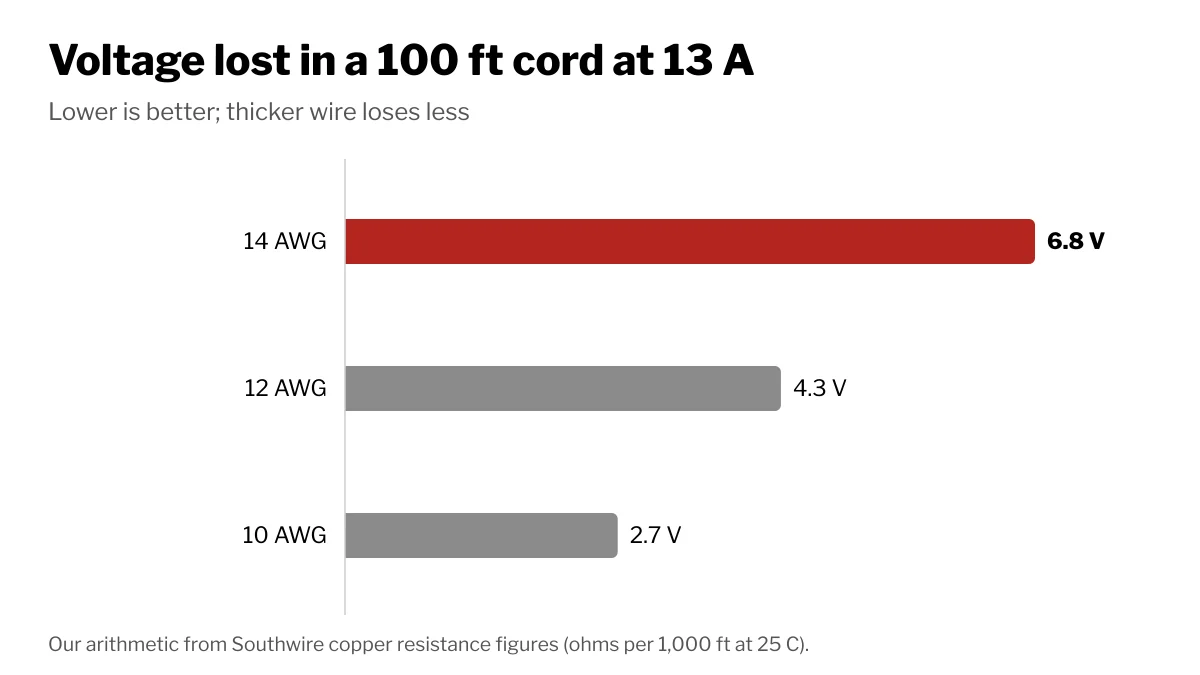
To show how much length matters, we worked out the drop for a 100 foot cord carrying 13 amps, using Southwire's copper resistance at 25°C:
| Gauge | Voltage lost | Share of 120 volts |
|---|---|---|
| 14 AWG | About 6.8 V | 5.7% |
| 12 AWG | About 4.3 V | 3.6% |
| 10 AWG | About 2.7 V | 2.3% |
Current travels out and back, so a 100 foot cord means 200 feet of wire. Real cords use stranded wire and warm up in use, so treat these as estimates. The pattern holds: each step thicker cuts the loss.
Read the jacket
OSHA explains that cord jackets carry a code printed about every foot. S, ST, SO and STO mark hard service cord; SJ, SJO, SJT and SJTO mark junior hard service. OSHA's construction rules require hard or extra-hard usage cord on job sites, and the cord must be 3-wire so tools can be grounded. Southwire's outdoor cords above are marked SJTW.
On Wiki Shopping, 30 of the 90 extension cord listings in tools and home improvement on October 26, 2026 state 13 amps and 16 state 15 amps. Most are short: 24 list 6 feet, 15 list 10 feet and 13 list 3 feet.
How we count
Amp and length counts are read from each store listing on Wiki Shopping. Listings that do not state them are left out, and the counts change as listings are added or removed. The voltage drop figures are our arithmetic from Southwire's resistance table.