Planner Formats, Daily vs Weekly vs Undated
A daily planner gives each day a page or two, a weekly planner shows the week on two pages, and an undated planner lets you start any time.

By Antonio SmithamContributing writer.
On this page
The short answer
Planners differ in three ways: how much space each day gets (the layout), whether the dates are printed (dated or undated), and the page size. Choose the layout first, because it decides how much you can write for each day.
Daily vs weekly planner
Day-Timer sells its refills in three main layouts:
| Layout | Pages | Best for |
|---|---|---|
| Daily, 2 pages per day | 2 per day | Full days of appointments, notes and records |
| Daily, 1 page per day | 1 per day | Detailed days with less writing |
| Weekly | 2 per week | Seeing the whole week's tasks and appointments at once |
| Monthly | 2 per month | Long-range goals, deadlines and projects |
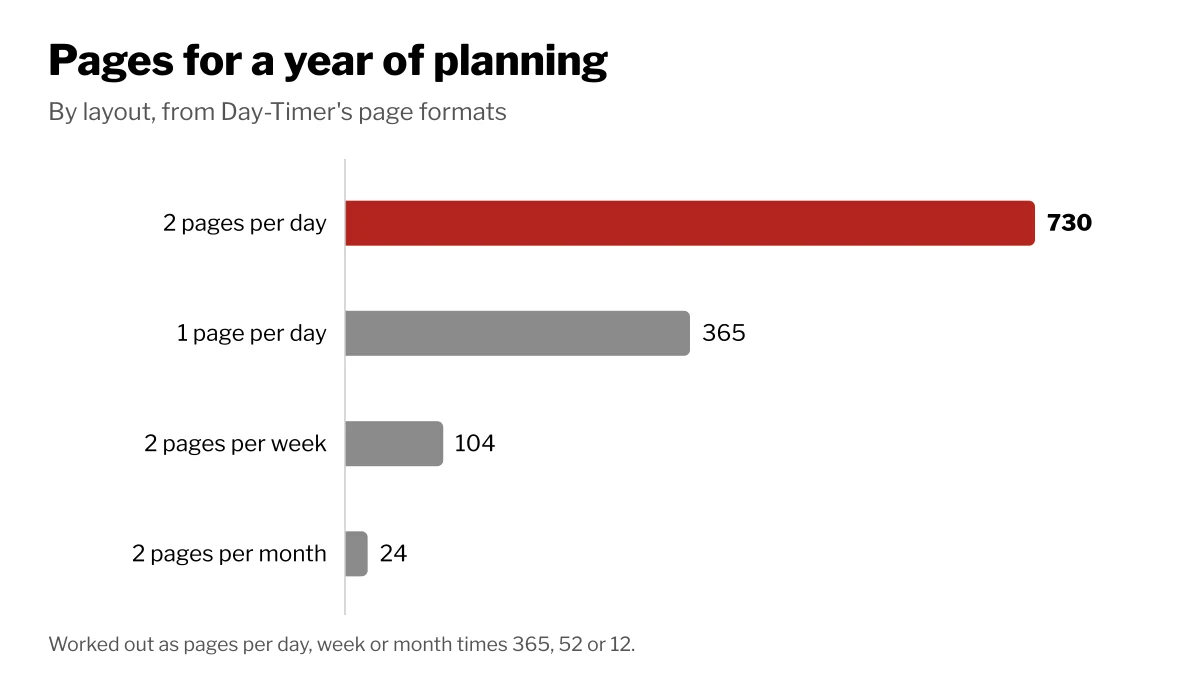
The daily pages carry hourly appointment lines, note space and a to-do area. The trade-off is bulk: a full year at two pages per day runs to 730 pages, while a weekly layout needs 104 and a monthly one 24.
- Pick daily if your days are packed with meetings or you keep notes and records in the planner.
- Pick weekly if you mostly need to see what is coming up this week and have a few lines per day.
- Pick monthly if you track deadlines and events more than hour-by-hour plans.
Undated vs dated planner
A dated planner has the calendar printed in. It gives structure and can help you plan consistently, and you can pick up where today falls without writing anything.
An undated planner leaves the dates blank, and you fill them in as you go. Erin Condren points out the main benefit: you can start at any point in the year, and if you stop for a few weeks, you simply pick up on the next page instead of leaving blank pages behind.
- Dated suits people who plan every day and want the calendar done for them.
- Undated suits people who start mid-year or plan in bursts.
Dated planners also come with different start months. Day-Timer refills, for example, start in January or July, so you do not have to wait for a new calendar year.
Planner sizes
Size decides whether the planner lives on a desk or in a bag. Day-Timer sells these sizes:
| Size name | Page size |
|---|---|
| Folio (loose-leaf) / Notebook (wirebound) | 8.5 x 11 in |
| Desk / Journal | 5.5 x 8.5 in |
| Portable | 3.75 x 6.75 in |
| 3.5 x 6.5 in | |
| Compact | 3 x 5 in |
| Jotter | 2.75 x 5 in |
Loose-leaf refills go into a matching binder cover, so you can add, move or replace pages. Wirebound planners are slimmer and come as one book.
How to choose a planner
- Count how many entries you make on a busy day. Many lines points to daily; a few points to weekly.
- Decide whether you plan every day (dated) or on and off (undated).
- Pick a size that fits where you will carry it.
- For loose-leaf, buy refills in the same size as your cover.
How we count
Layouts, sizes and start months come from Day-Timer's refill guide, and the undated planner points from Erin Condren's page. The yearly page counts multiply each layout by 365 days, 52 weeks or 12 months. On Wiki Shopping, 75 planners, refills and covers were listed under office products on October 26, 2026, and 33 of them are listed as planners.