Brass Mouthpiece Numbers, Explained
A brass mouthpiece name like 7C pairs a number for cup diameter with a letter for cup depth, but each maker runs its own scale, so read its chart.

By Andrian ChengContributing writer.
On this page
The short answer
Most brass mouthpiece names combine a number and a letter. The number stands for the cup diameter (how wide the opening inside the rim is), and the letter stands for the cup depth or volume. A 7C and a 3C share the same letter, so the cup shape is similar; the number tells you which one is wider.
The catch: there is no industry standard. One maker's larger number means a wider cup, another maker's larger number means a narrower one. Always read the chart of the brand you are buying.
The parts a size describes
A brass mouthpiece has four parts that change how it plays:
| Part | What it is | What a bigger or deeper one does |
|---|---|---|
| Rim | The ring your lips rest on | A wider inner diameter suits low notes; a smaller one helps high playing |
| Cup | The bowl behind the rim | A deeper cup darkens the sound; a shallow cup brightens it |
| Throat | The narrow hole after the cup | A larger throat gives more volume, with less control |
| Backbore | The tapered passage in the shank | A more conical bore gives a richer tone |
The instrument sets the overall scale. The reference article on brass mouthpieces gives a typical inner rim diameter of 16 mm for a trumpet and 32 mm for a tuba.
7C vs 3C, two numbering systems
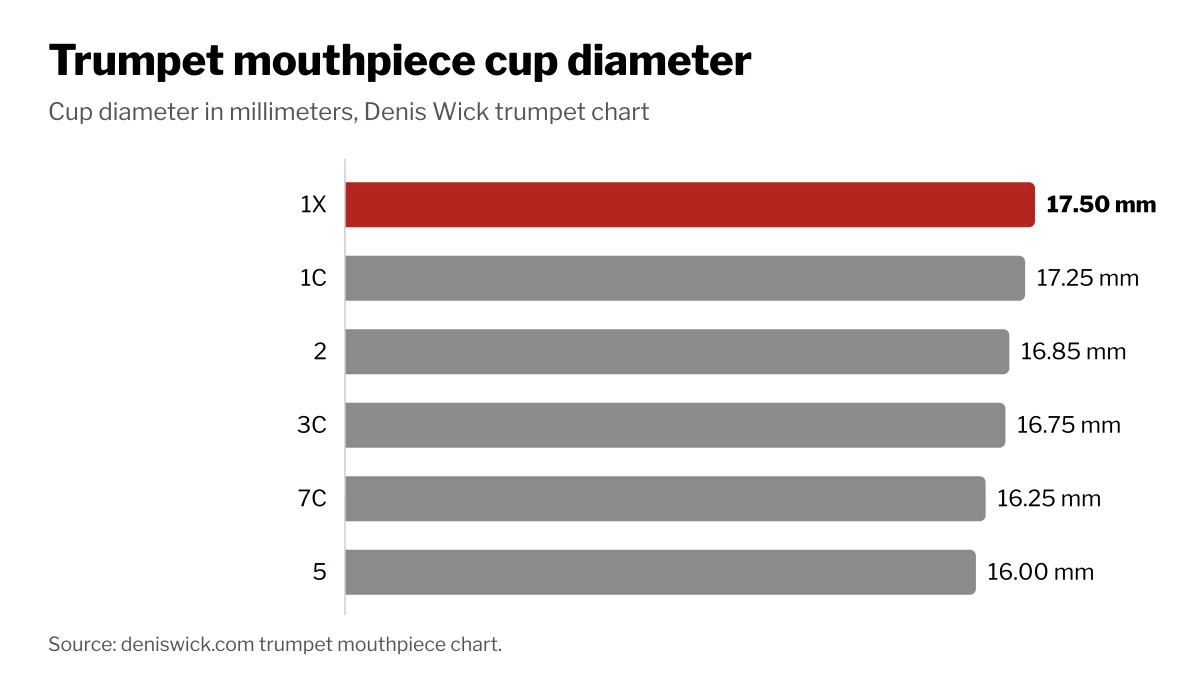
Denis Wick lists its trumpet mouthpieces from the largest cup to the smallest, and lower numbers sit at the large end. Its 3C has a 16.75 mm cup and its 7C a 16.25 mm cup, so in this system the 3C is the wider of the two. The letter shows the cup contour: E is shallow, C slightly shallow, B a little deep, and no letter means deep. The numbers do not follow a strict scale; Denis Wick's 7C (16.25 mm) is wider than its 5 (16.00 mm).
Schilke runs the other way. Its first number is the cup diameter, and the diameter grows as the number grows, from 5 to 24 in steps of 0.005 inch. The letter is cup volume, from A (most shallow) to E (large), with C as standard. A third digit gives the rim contour (1 roundest to 5 flattest) and a final small letter gives the backbore. A plain Schilke 14 is a 14C3c with the standard parts left out of the name.
Bach sells its Classic trumpet mouthpiece in a long run of sizes, including 1C, 3C, 5C and 7C, with letters from A to F on some sizes and a W suffix on others. Bach's product page lists the sizes but does not print the dimensions, so ask a dealer for the measurements before you compare.
How to read a size you do not know
- Find the maker's own chart and note the cup diameter in millimeters or inches.
- Compare letters only within the same brand.
- Change one thing at a time: a slightly wider cup or a slightly different depth, not both.
- Ask a teacher whether the rim size suits your lips.
How we count
The diameters in the chart and the section above come from Denis Wick's trumpet chart, and the Schilke rules from Schilke's labeling page. On Wiki Shopping, the 134 instrument mouthpieces listed under musical instruments on October 26, 2026 include 41 for trumpet, 13 for trombone and 7 for tuba, read from each listing's stated instrument; the rest do not state one.