Kayak Paddle Length Chart and Blade Materials
Kayak paddle length depends on boat width and your height, from about 200 cm for a narrow boat and short paddler to 250 cm for a wide boat and tall paddler.

By Adolph GreenContributing writer.
On this page
The short answer
Two numbers set your kayak paddle length: the width of the kayak at its widest point and your height. A wider boat needs a longer paddle so the blade can reach the water, and a taller paddler needs a little more length too. Paddle lengths are given in centimeters, usually in 10 cm steps.
A paddle that is too short makes you lean out or knock your knuckles on the hull. One that is too long swings more weight with every stroke and gives you less control, as Bending Branches explains in its sizing guide.
Kayak paddle length chart
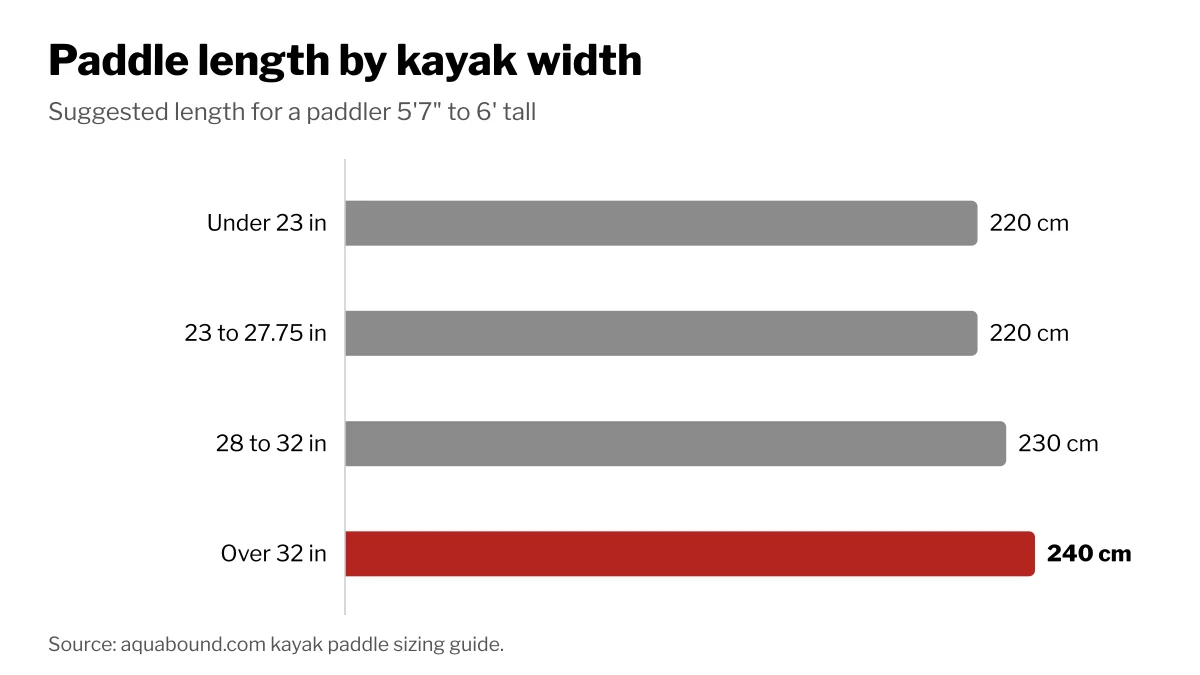
This chart comes from Aqua-Bound's kayak paddle sizing guide, for recreational, touring and performance kayaks:
| Kayak width | Under 5' | 5' to 5'6" | 5'7" to 6' | Over 6' |
|---|---|---|---|---|
| Under 23 in | 200 cm | 210 cm | 220 cm | 220 cm |
| 23 to 27.75 in | 210 cm | 220 cm | 220 cm | 230 cm |
| 28 to 32 in | 220 cm | 230 cm | 230 cm | 240 cm |
| Over 32 in | 230 cm | 240 cm | 240 cm | 250 cm |
If you do not know the width, Aqua-Bound gives typical ranges: recreational kayaks run 26 to 30 inches wide, touring kayaks 22 to 25 inches and performance kayaks 19 to 22 inches. Whitewater paddles follow a separate chart that leans on height more than width.
When to go longer or shorter
Both Aqua-Bound and Bending Branches suggest adding 5 cm or more when two or more of these apply: a relaxed pace, a low-angle stroke, an unusually wide or flat-bottomed boat, or a high seat. Go 5 cm or more shorter for a fast, aggressive pace, a high-angle stroke, an unusually narrow boat or a low seat.
Fishing kayaks are a case of their own. They are wide and often have a raised seat, so Bending Branches puts most fishing paddles at 240 to 260 cm and suggests sizing up 10 cm if you mostly fish from the high seat position. An adjustable-length shaft covers both seat heights.
High-angle vs low-angle paddling
- Low angle: the shaft stays fairly flat and the stroke is relaxed. It suits recreational and touring days and pairs with a longer paddle and a long, narrow blade.
- High angle: the shaft is held more upright for a faster, more powerful stroke. Werner pairs its high-angle blades with shorter paddles of about 205 to 215 cm.
Fiberglass vs carbon kayak paddles
Material changes the weight you swing on every stroke and the stiffness of the paddle.
| Material | What makers say |
|---|---|
| Recreational-grade paddles | Durable and lowest in cost, but heavier than touring or performance paddles (Aqua-Bound) |
| Fiberglass | Light swing weight and stiffness at a middle price (Werner) |
| Carbon | Stiffer, so less material gives the same strength; the lightest option (Werner) |
Aqua-Bound adds that carbon and fiberglass shafts feel warmer in the hand than aluminum, and that lighter paddles are worth considering for long trips or sore shoulders.
Shopping for paddles on Wiki Shopping
Paddle listings sit in the sports and outdoors department. Check the length on the store page against the chart above, and read our guide to kayak sizes to see how width and length change the boat.