Saxophone Types: Alto vs Tenor and Beginner Picks
The alto sax is pitched in E flat and the tenor in B flat; Yamaha points beginners to the alto as easier to play, and its fingering carries over to every sax.

By Andrian ChengContributing writer.
On this page

The short answer
For most new players, the alto saxophone is the place to start. Yamaha's instrument guide calls the alto easier to play than the soprano and a good first choice, and because every saxophone uses essentially the same fingering, the skills move with you if you later switch to tenor, soprano or baritone.
Pick the tenor first if the music you want to play is built around it, or if your band director asks for one.
The saxophone family
Adolphe Sax, a Belgian instrument designer, came up with the saxophone in the 1840s and patented it in Paris in 1846, according to Yamaha. He built 14 sizes, but six are in wide use today. From highest to lowest pitch:
| Saxophone | Key | Notes |
|---|---|---|
| Sopranino | Not covered in the guide | The highest |
| Soprano | B flat | Shorter tube than the alto |
| Alto | E flat | The usual beginner sax |
| Tenor | B flat | Lower than the alto |
| Baritone | E flat | The only one with a low A key |
| Bass | Not covered in the guide | The lowest of the six |
The keys come from Yamaha's guide on transposing, which covers the four most common saxes. Even though it is made of brass, the saxophone counts as a woodwind because it makes its sound with a reed.
Alto vs tenor
The two most common saxes differ in pitch and in how music is written for them:
- Alto (E flat): a written C sounds as the E flat on a piano.
- Tenor (B flat): a written C sounds as a B flat, like a clarinet.
Fingerings stay the same, so a tenor player reading the same part as an alto player sounds different notes. That only matters when you share music; parts are normally printed for each instrument's key.
Yamaha also compares the alto and soprano: both are about 70 centimeters long, but the alto's bend makes its tube about 1.5 times longer, so it is heavier. The strap carries most of that weight when you play.
Starting setup
Yamaha suggests beginners use a standard mouthpiece (its 4C) with a 2.5 reed. Reed strength usually runs from 2 to 5; thinner reeds vibrate more easily and sound brighter, while harder reeds take more skill and give a fuller tone. See mouthpiece numbers for more on facings and tip openings.
Student, intermediate or professional
Saxophones are often sold by player level. On Wiki Shopping, 13 are listed as student, 9 as intermediate and 11 as professional. Another 8 are sold as a kit.
How we count
Type and player level are read from each saxophone's store listing on October 27, 2026, out of 66 saxophones listed. Saxophones of other types, or that do not state one, are left out of those counts. The counts change as listings are added or removed.
Shop by spec
Saxophones
Alto, Student, Gold
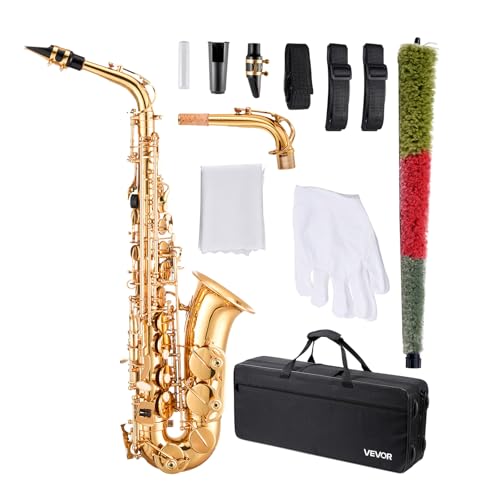
- E Flat Alto Saxophone: This saxophone beginner kit features a wide range of 33-note range (B♭ - F#) and 23 keys. It is great for all types of music, from classic swing and jazz ensembles to solo performances. Ideal for beginners and hobbyists
- Clear, Stable Sound Quality: With brass construction and electrophoretic coating, this alto saxophone allows the natural resonance of the brass to shine through, producing a clear sound. Enjoy a stable tone and smooth response with every note
- Comfortable Shell Keys: The shell keys are made from polished shell material, providing a comfortable touch. Designed with ergonomics in mind to naturally fit your fingers, these keys ensure a better playing experience
- 2-in-1 Carrying Case: This student alto saxophone comes with a convenient carrying case that includes a shoulder strap, keeping your instrument secure and clean while making it easy to carry for outdoor performances
- Ready to Play Out of the Box: Everything you need to get started is included: a carrying case with strap, mouthpiece, cleaning cloth, cleaning rod, gloves, grease, neck strap, and neck tube. Just unbox and start playing
Soprano

- 15-step volume adjustment
- Headphone Terminal , Aux in jack
- 73 voices, including 56 for saxophone
- The same key layout as an acoustic saxophone
- Specially designed mouthpiece
Alto, Professional, Gold
 Yamaha YAS-62III Professional Alto Saxophone - Gold Lacquer
- Demo 62 III Pro Alto Sax Laq
Digital

- Integrated Brass Bell Acoustic System
- Digital Saxophone with 73 Voices
- Standard Sax Key Layout
- Synthetic Reed
- Mouthpiece