Jacket Waterproof Ratings in mm, and Breathability
A jacket's waterproof rating in mm is the water column the fabric holds before it leaks; about 10,000 mm suits moderate rain and 20,000 mm and up storms.

By Adolph GreenContributing writer.
On this page
The short answer
A rain or ski jacket often shows two numbers, such as 10,000 mm / 10,000 g, sometimes shortened to 10K/10K:
- The mm number is waterproofing. It is the height of a column of water, in millimeters, that the fabric holds before water pushes through. Higher means it stays dry under more pressure.
- The g number is breathability. It is how many grams of water vapor (your sweat) pass through one square meter of the fabric in 24 hours. Higher means less clammy.
Both outerwear guides used here agree that around 10,000 mm is where technical jackets start, and that 20,000 mm and above is for the wettest conditions.
How the mm rating is measured
In the water column test, a tube about one inch across is stood on a piece of the fabric and filled with water. The rating is how high the water can rise before drops come through the other side. Pressure matters as well as rain: kneeling in wet snow, a pack strap pressing on your shoulders or wind driving the rain all push water into the fabric harder than drizzle does.
Waterproof rating chart
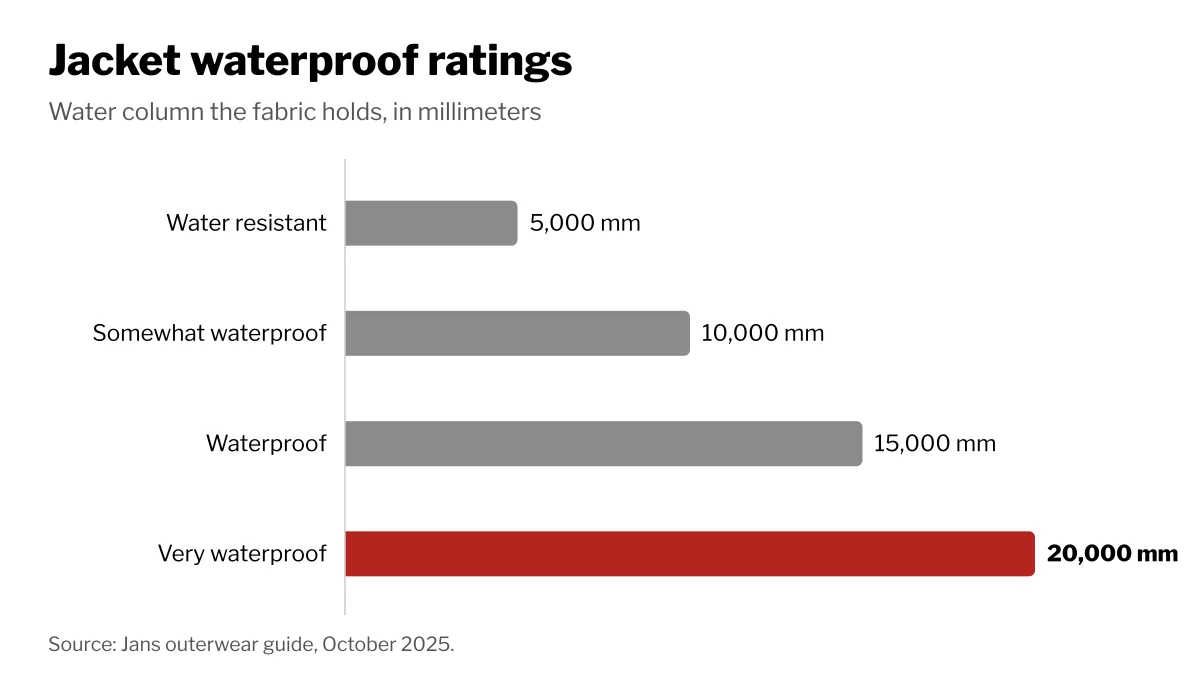
Outdoor retailer Jans describes the levels this way in its October 2025 guide:
| Rating | Description | Fits |
|---|---|---|
| Under 5,000 mm | Lightly water resistant | Mist, a brief splash |
| 5,000 mm (5K) | Water resistant | Light rain, dry snow, everyday wear |
| 10,000 mm (10K) | Somewhat waterproof | Moderate rain and average snow, light pressure |
| 15,000 mm (15K) | Waterproof | Moderate rain and snow under moderate pressure; a baseline for skiing and hiking |
| 20,000 mm (20K) | Very waterproof | Heavy rain and wet snow under heavy pressure |
| Over 20,000 mm | Maximum | Expeditions and extreme conditions |
FashionUnited's 2025 explainer gives a matching picture: technical outdoor jackets often reach 10,000 mm or more, and expedition models reach 20,000 to 30,000 mm.
Breathability ratings
Breathability is reported two ways:
- MVTR in g/m2/24h: higher is better. Jans calls 5,000 g or less only slightly breathable, 10,000 g enough for moderate activity like hiking, and 20,000 g very breathable for skiing, trail running and climbing. FashionUnited also treats 10,000 g or more as highly breathable.
- RET: lower is better. FashionUnited lists under 6 as excellent and 6 to 13 as good.
Jans notes there is no single industry standard for testing breathability, and temperature and humidity change the results, so compare these numbers loosely, ideally within one brand.
What else keeps you dry
- Taped seams. Stitch holes leak. Good rain jackets seal every seam with heat applied tape, so look for "fully taped" or "fully sealed" seams.
- DWR finish. A durable water repellent coating on the outer fabric makes rain bead up and roll off. It wears down with dirt, rubbing and washing, and needs to be renewed from time to time.
- Membrane or coating. Waterproof breathable jackets use either a separate membrane under the outer fabric or a thin coating on the inside of it.
Which rating to look for
For a city rain jacket, 5,000 to 10,000 mm is usually enough. For hiking and resort skiing, the guides point to about 15,000 mm. For all day storms, backcountry trips or kids rolling around in wet snow, 20,000 mm or more with fully taped seams. If you work hard in the jacket, give breathability as much weight as the mm number.