Cooktop Types Explained
Gas burns a flame, radiant electric heats a coil or glass, and induction heats the pan with a magnetic field; ENERGY STAR rates induction near 85% efficient.

By Liam McCabeContributing writer.
On this page
The short answer
A cooktop is the burner surface without an oven. There are three main kinds:
- Gas: a flame under the pan. You see the heat and it reacts at once.
- Electric (radiant or coil): an element heats up, then passes that heat to the pan. Most have a smooth glass top over the elements.
- Induction: a coil under the glass makes a magnetic field that heats a compatible pan directly. The glass itself only gets warm from the pan.
How does an induction cooktop work
Under each zone sits an electromagnetic coil. When current runs through it, it creates a magnetic field, and a pan made of magnetic (ferromagnetic) metal heats up from the inside. Without a pan in place, nothing heats. ENERGY STAR notes that an induction surface is not hot to the touch when there is no pot or pan on it.
That is also the catch: the pan must be magnetic. ENERGY STAR's test is simple. Hold a magnet to the bottom of the pan; if it sticks, the pan works on induction. Cast iron, enameled cast iron and many stainless steel pans pass. Plain aluminum, copper and glass do not, unless they have a magnetic base.
Induction vs electric cooktop
ENERGY STAR gives these approximate efficiencies, meaning the share of the energy that ends up in the food:
| Cooktop | Approximate efficiency |
|---|---|
| Gas | About 32% |
| Electric resistance (radiant or coil) | About 75% to 80% |
| Induction | About 85% |
It also says boiling water on induction can take nearly half the time it takes on gas, radiant or coil, and that less heat escapes into the kitchen. A radiant electric cooktop costs less and works with any flat pan, but it heats and cools more slowly, and the glass stays hot for a while after you turn it off.
Sizes and power
Cooktops are sold by width. On Wiki Shopping, 26 cooktops list a 30-inch width, 10 list 24 inches, 6 list 36 inches and 16 list 12 inches. A 12-inch unit is usually a one or two burner portable model, while 30 and 36 inches are built-in sizes that drop into a counter cutout. Measure the cutout, not the old cooktop's glass, before you buy.
Voltage matters too: 12 cooktops list 110V, which runs from a standard outlet, and 12 list 240V, which needs a dedicated circuit. Check what your kitchen has, and use an electrician for a new 240V line.
Is an induction cooktop worth it
Induction is worth a look if you want fast boiling, precise low heat and a top that is easy to wipe clean, and if most of your pans pass the magnet test. It costs more than a radiant cooktop and may mean buying a few new pans. If you love cooking over a flame or have a gas line and no 240V circuit, a gas cooktop is still the simpler swap. A portable induction burner is a cheap way to try it first.
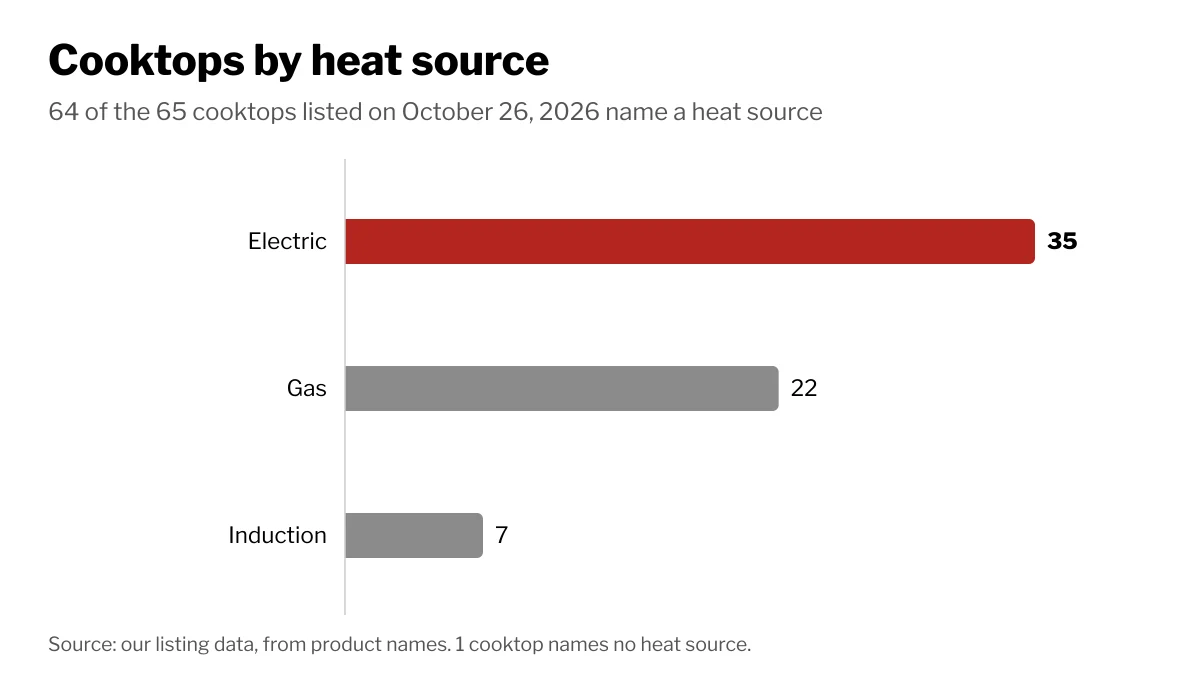
How we count
Wiki Shopping lists 65 cooktops in the appliances department. The heat source comes from each product's name: names with "induction" count as induction, names with "gas" or "propane" as gas, and names with "electric", "radiant" or "ceramic" as electric. One cooktop names none of these. Width and voltage are read from the store listing; cooktops that do not state them are left out of those counts.