What Size Generator Do I Need? Watts Explained
Add up the running watts of everything you will power at once, then make sure the generator's starting watts cover the biggest motor as it kicks on.

By Damien VolkmanContributing writer.
On this page

The short answer
A generator has two ratings. Running watts is what it can supply continuously; starting watts is the short burst it can give when a motor, such as a fridge compressor or a pump, first starts. To size one, add the running watts of everything you want on at the same time, then check that the extra surge of the largest motor still fits under the starting rating.
What size generator do I need?
Champion Power Equipment publishes a wattage chart for common loads. A few examples from it:
| Appliance | Running watts | Starting watts |
|---|---|---|
| Refrigerator | 150 to 400 | 800 to 1,200 |
| Sump pump (1/2 HP) | 800 to 1,050 | 1,300 to 2,150 |
| Window AC (10,000 BTU) | 900 to 1,200 | 1,800 to 2,400 |
| Microwave | 600 to 1,200 | No extra |
| Space heater | 750 to 1,500 | No extra |
| Internet router or modem | 10 to 20 | No extra |
| Central AC (3 ton) | 3,000 to 3,500 | 5,000 to 6,000 |
Champion notes that heaters, microwaves and electronics need no extra starting watts, so you size for those on running watts alone. A simple method:
- List what must run during an outage or at camp.
- Add their running watts.
- Find the single largest starting surge and add the difference between its starting and running watts.
- Pick a generator rated above that total; use your appliance labels where you can.
On Wiki Shopping, the generator listings that state a wattage break down as 13 under 3,000 watts, 22 from 3,000 to 5,000, 13 from 5,001 to 9,000 and 39 over 9,000.
Inverter vs conventional generator
| Inverter | Conventional | |
|---|---|---|
| Output | Converted electronically, stable voltage and frequency | Straight from the alternator |
| Engine speed | Slows down at light loads | Holds a set speed to keep the output at 60 Hz |
| Noise and fuel | Quieter, more fuel efficient | Louder in Champion's specs (see below) |
| Sensitive electronics | Suited, thanks to low harmonic distortion | May need a power conditioner |
Wikipedia explains that an inverter model can slow its engine to match the load, cutting noise and fuel use, and that its low harmonic distortion suits computers. Champion's 2000 watt inverter is rated under 3% THD (total harmonic distortion) and 53 dBA at 23 feet, against 68 dBA for its 3550 watt conventional model.
Of the 81 generators listed on Wiki Shopping on October 26, 2026, 40 are inverter models, 23 conventional portables and 18 standby units.
How long can a generator run?
Run time depends on tank size and load, and makers quote it at a stated load, so compare like with like. Champion rates its 2000 watt inverter at up to 11 hours at a quarter load on a 1.1 gallon tank, and its 3550 watt model at up to 14 hours at half load on a 4.7 gallon tank.
Run a portable generator outdoors only. Wikipedia sums up the safety advice: never in a house, garage or partly enclosed space, and away from windows, doors and vents, because carbon monoxide can build to fatal levels. On Wiki Shopping, 25 generators list a carbon monoxide sensor.
How we count
Type, wattage and features are read from each generator's store listing. Generators that do not state them are left out of those counts. The counts change as listings are added or removed.
Shop by spec
Generators
Portable, Tri Fuel, Over 9000 W

- Automatic Home Backup Made Portable: Pair with the Westinghouse WATS200 Automatic Transfer Switch for automatic backup power. This revolutionary, first-of-its-kind technology combines standby convenience with portable versatility. Exclusive to Westinghouse. Switch sold separately.
- Built for Longer Engine Life: The powerful 500cc engine features a pressure lubrication system that delivers oil to critical components, reducing friction and wear. A reusable oil screen captures abrasive particles and contaminants for cleaner oil and long-lasting engine performance.
- Less refueling, easy starting: Runs up to 19 hours at 25% load on a 9.5-gallon gasoline tank. Start with the push of a button or the included remote key fob; backup recoil starting adds flexibility. A built-in fuel gauge makes fuel checks easy.
- Fuel flexibility: Choose gasoline, propane or natural gas. Delivers 10,500 running/13,500 peak watts on gasoline. 50A and 30A outlets pair well with an interlock kit, manual transfer switch or Westinghouse WATS200 ATS system for home backup (sold separately).
- Built-in safety and support: Automatic low-oil shutdown helps protect the engine, while the CO sensor shuts down the generator when elevated carbon monoxide is detected. Backed by a 3-year limited residential warranty and lifetime technical support.
Portable, Dual Fuel, 5001 to 9000 W
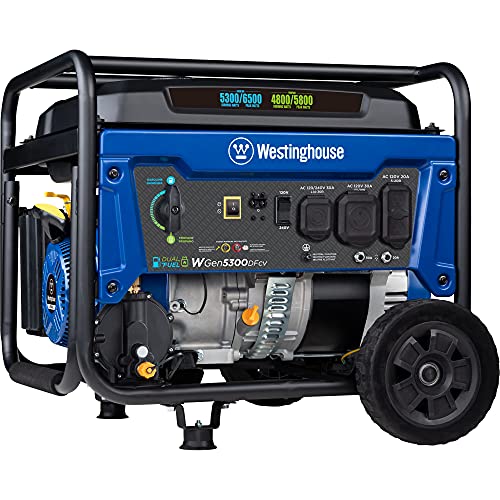
- Gasoline: 5300 Running Watts & 6500 Peak Watts; Propane: 4800 Running Watts & 5800 Peak Watts; 4.7 Gallon Fuel Tank with Fuel Gauge; Up to 14.5 Hours of Run Time with 120/240V Volt Selector Switch
- Features One 5–20R 120V 20V Household Duplex Receptacle, One RV-Ready TT-30R 30A Receptacle, and One Transfer Switch Ready L14-30R 30A Receptacle; All Outlets Have Rubber Covers for Added Safety
- Plug-and-Play: Comes with Oil, an Oil Funnel, Propane Hose, Tool Kit, Wheel Kit, and a User’s Manual to Get You Started Right Out of the Box (Minimal Assembly Required)
- Powered by a 274 CC Westinghouse 4-Stroke OHV Engine Featuring a Long-Lasting Cast Iron Sleeve with Automatic Low Oil and Carbon Monoxide (CO) Shutdown
- All Westinghouse Portable Generators are Functionally Tested in the Factory and May Contain Minimum Residual Oil and/or Fuel Odor; EPA Compliant; Backed By 3-Year Limited Service, Labor, and Parts Coverage and Nationwide Customer Service Network
Portable, Dual Fuel, 3000 to 5000 W
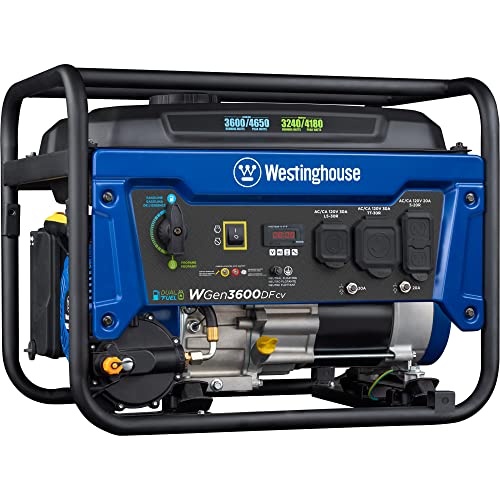
- 4650 Peak Watts & 3600 Rated Watts (Gasoline); 4650 Peak Watts & 3240 Rated Watts (Propane); 4 Gallon Fuel Tank (with Fuel Gauge); Up To 14 Hours of Run Time Per Tank
- Features One 5-20R 120V Household Duplex Receptacle, One RV-Ready TT-30R 30 Amp Receptacle, and One L5-30R 30 Amp Receptacle; All Outlets Have Rubber Covers for Added Safety
- Plug-and-Play: Comes with Oil, an Oil Funnel, a Tool Kit, and a User's Manual to Get You Started Right Out of the Box (Minimal Assembly Required)
- Powered by a 212cc Westinghouse 4-Stroke OHV Engine Featuring a Long-Lasting Cast Iron Sleeve with Automatic Low Oil and Carbon Monoxide (CO) Shutdown
- All Westinghouse Portable Generators are Functionally Tested in the Factory and May Contain Minimum Residual Oil and/or Fuel Odor; EPA Compliant; Backed By 3-Year Limited Service, Labor, and Parts Coverage and Nationwide Customer Service Network
Portable, Dual Fuel, Over 9000 W

- 9500 Running Watts and 12500 Peak Watts (Gasoline); 8500 Running Watts, 11200 Peak Watts (Propane); Remote Start with Included Key Fob, Electric and Recoil Start; Up to 12 Hours of Run Time on a 6. 6 Gallon Fuel Tank with Fuel Gauge
- Features Two GFCI 120V 5–20R 20A Standard Household Receptacle, One Transfer Switch Ready 120V L14-30R 30A, and One RV Ready 120/240V 14–50R 50A; All Outlets Have Rubber Covers for Added Safety
- Powered by a Heavy Duty 457cc Westinghouse 4-Stroke OHV Engine Featuring a Long-Lasting Cast Iron Sleeve with Automatic Low Oil and Carbon Monoxide (CO) Shutdown, and Digital Hour Meter
- Plug-and-Play: Comes with a Remote Start Key Fob, 12V Battery Charger, Oil, and Oil Funnel, a Tool Kit, and a User’s Manual to Get You Started Right Out of the Box (Minimal Assembly Required)
- All Westinghouse Portable Generators are Functionally Tested in the Factory and May Contain Minimum Residual Oil and/or Fuel Odor; EPA Compliant; Backed By 3-Year Limited Service, Labor, and Parts Coverage and Nationwide Customer Service Network