Patio Heater Types: Propane, Natural Gas, Electric
Propane patio heaters are portable and run on a tank, natural gas heaters connect to a gas line, and electric heaters plug in but put out less heat.

By Karson AbernathyContributing writer.
On this page
The short answer
- Propane: warms up fast and moves around the patio, but you refill or swap the tank.
- Natural gas: runs from your home's gas line, so no tank to refill, but it stays where a professional installs it.
- Electric: the easiest to set up and works in covered or partly enclosed spaces, but it puts out less heat than gas and adds to the power bill.
This Old House sums up the trade-offs the same way in its 2025 patio heater guide.
How heat output is measured
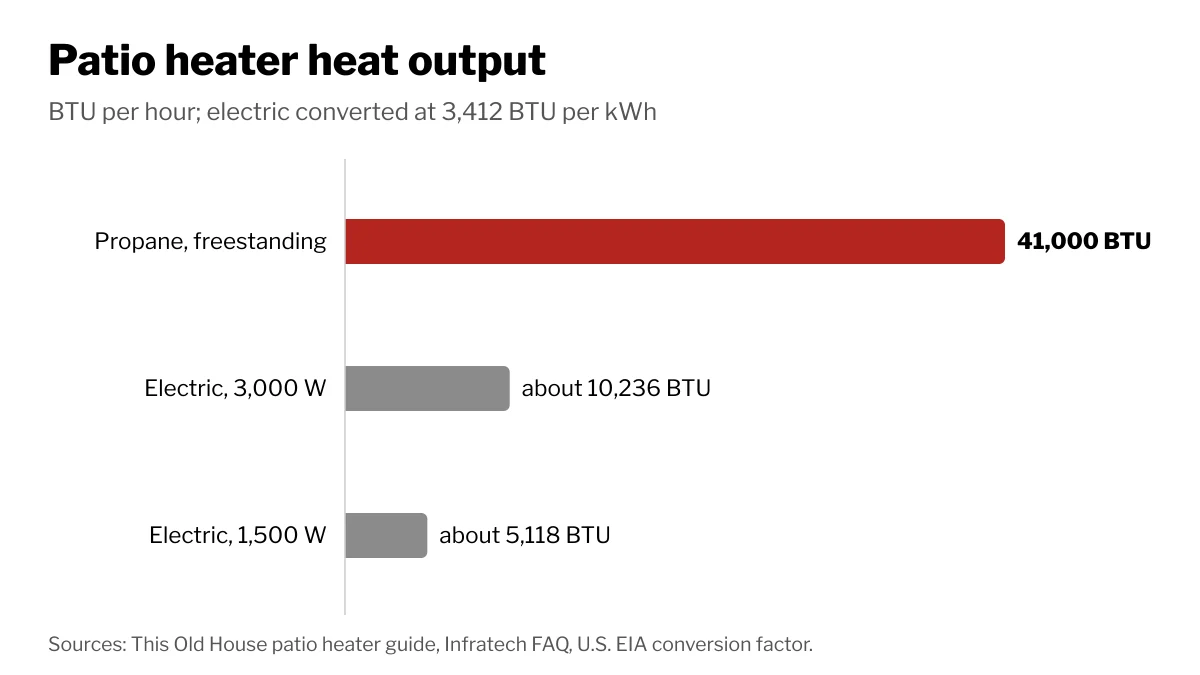
Gas heaters are rated in BTU (British thermal units) per hour. Electric heaters are rated in watts, which you can convert: the U.S. Energy Information Administration puts 1 kilowatt-hour at 3,412 BTU.
| Heater | Rated power | Heat output |
|---|---|---|
| Electric, 120 volt plug-in size | 1,500 watts | about 5,118 BTU per hour |
| Electric, wired heater | 3,000 watts | about 10,236 BTU per hour |
| Propane, freestanding (FDW model in This Old House's guide) | n/a | 41,000 BTU per hour |
The gap is large: one freestanding propane heater in that guide puts out about eight times the heat of a 1,500 watt electric heater.
Propane patio heaters
Most freestanding mushroom or pyramid heaters run on propane, often with wheels to move them. This Old House says a propane heater typically runs about 10 hours on a 20 pound tank, and the small tabletop model in its guide lasts up to three hours on a 1 pound tank. Propane burns, so it can cause carbon monoxide poisoning in enclosed areas. Use it outdoors only, and never set a heater on grass, where it can tip or start a fire.
Natural gas patio heaters
A natural gas heater is about as large as a propane one but is usually fixed in place, because a professional connects it to your gas line. You trade portability for fuel that does not run out mid-evening. It fits a patio you use often, in the same spot.
Electric patio heaters
Electric heaters come freestanding, wall mounted or ceiling mounted, and This Old House notes they work indoors as well as outdoors. Mounted units take more installation than a freestanding heater.
Voltage matters. Infratech, which makes electric infrared heaters, says a 120 volt heater tops out at 1,500 watts and suits a garage or an outdoor area no larger than about 5 by 5 feet; larger areas call for a 240 volt circuit. It also warns that a 240 volt heater run on 208 volt power gives only about 60% of its rated heat, so check your supply before you buy.
To estimate running cost, multiply the heater's kilowatts by your power rate per kilowatt-hour. Infratech's example: a 3,000 watt heater at 13 cents per kWh costs 39 cents an hour at full power.
Which type fits your patio
| If you want | Look at |
|---|---|
| Strong heat you can move around | Propane |
| A permanent heater with no tank swaps | Natural gas |
| A covered porch or partly enclosed space | Electric |
| Warmth at one small table | Tabletop propane |
Whatever the fuel, follow the clearance distances in the maker's manual and look for tip-over and overheat shutoff, which This Old House lists as common safety features.
How we count
Wiki Shopping lists 67 patio heaters under patio, lawn and garden as of October 27, 2026, from our read-only listing data. Fuel type is not yet a filter on our listings, so we do not count them by fuel. The counts change as listings are added or removed.