Hockey Stick Flex and Length, Explained
A hockey stick's flex number tells you how stiff it is; Bauer suggests starting a bit under half your body weight in pounds, and a cut stick gets stiffer.

By Adolph GreenContributing writer.
On this page
The short answer
The flex number printed on a hockey stick shaft tells you how stiff it is. A higher number is stiffer, which suits strong players and hard slapshots. A lower number bends more easily, which helps lighter players load the stick and get power into a shot. Bauer's buying guide suggests starting with a flex a little under half your body weight in pounds. A 150 pound player would start just under 75, for example.
What does flex mean on a hockey stick?
Hockey sticks are built to bend, and Bauer calls that bend the flex. The number on the shaft is a stiffness scale: the higher the number, the stiffer the feel. Picking the right one can help you put more power into your shots.
A stiff stick rewards a strong player who can bend it on a full slapshot. A softer, whippier stick is easier to bend, which is why Bauer points lighter players to lower numbers. That is why body weight is the starting point.
What flex hockey stick do I need?
- Start with about half your body weight, then go a little lower.
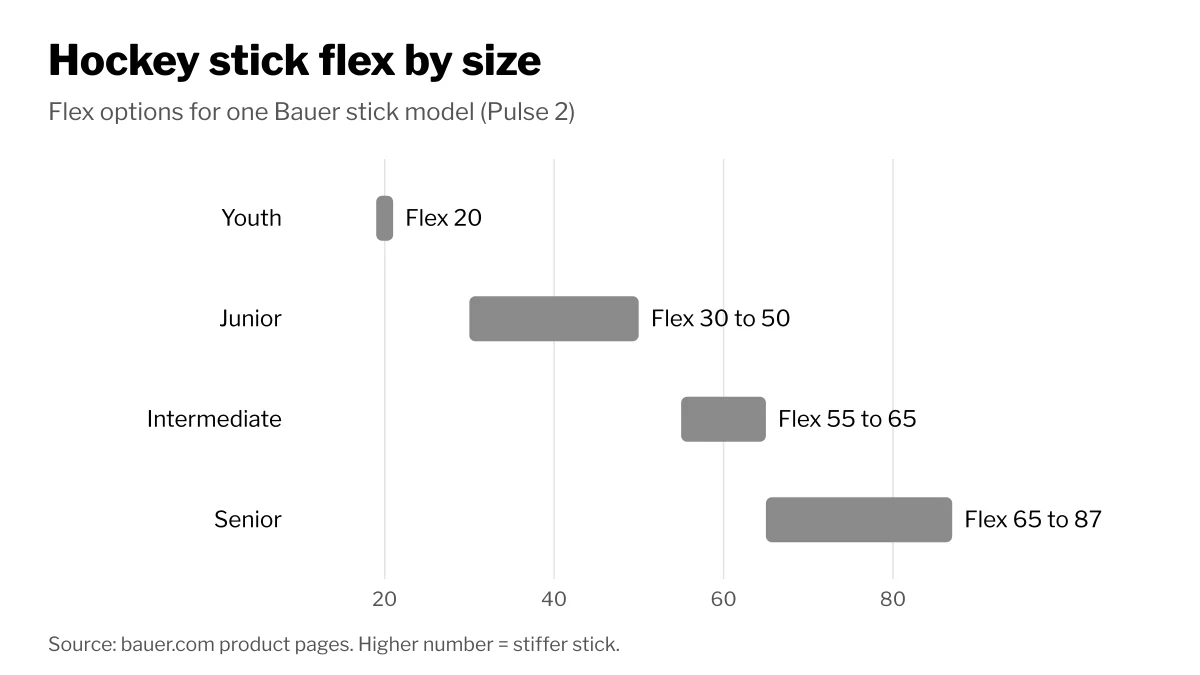
- Pick the stick size class that offers that flex. On one current Bauer model, the Pulse 2, the options run like this:
| Stick size | Flex options (Bauer Pulse 2) |
|---|---|
| Youth | 20 |
| Junior | 30, 40, 50 |
| Intermediate | 55, 65 |
| Senior | 65, 70, 77, 87 |
Other models and brands offer different steps, so check the flex list on the product page.
- Think about where the stick bends. Bauer calls this the kick point. A low kick point flexes near the blade for a quick release; a mid kick point flexes in the middle of the shaft and helps add speed to bigger shots.
Hockey stick size chart
Bauer's sizing advice for length:
| How you measure | Where the top of the stick should reach |
|---|---|
| Standing in shoes, stick upright | About nose height |
| On skates, stick upright | Between chin and bottom lip |
Bauer measures length from the top of the shaft to the ground. Its flex guide notes that length goes with flex: a flex 30 stick may be about 50 inches long, while a flex 87 stick may be about 62 inches.
Cutting or extending changes the flex
If a stick is too tall or too short, you can cut it down or add an extension, but Bauer warns that cutting raises the flex number (the stick gets stiffer) and an extension lowers it. Most Bauer sticks print this change on the shaft, so check the marks before you cut.
Bauer adds that these are suggestions, not rules. Once you know what you like, your own preference counts more than any chart.
Shopping for sticks on Wiki Shopping
Hockey gear sits in the sports and outdoors department. On the store page, check the size class (youth, junior, intermediate or senior), the flex number and the curve before you buy.