Pressure Washer PSI vs GPM, Explained
PSI is how hard the water hits and GPM is how much water flows each minute; multiply the two and you get cleaning units, a quick way to compare machines.

By Andrian ChengContributing writer.
On this page
The short answer
Every pressure washer lists two numbers, and they do different jobs:
- PSI (pounds per square inch) is the pressure. It is the force that knocks grime loose from the surface.
- GPM (gallons per minute) is the flow. It is the volume of water that carries the loosened dirt away.
Simpson, a pressure washer maker, compares PSI to the speed of a ball and GPM to its size: at the same speed, a bowling ball hits harder than a baseball. A machine needs both numbers to clean well, and a high PSI with a weak flow still leaves dirt behind because there is not enough water to rinse it off.
Cleaning units: one number for both
Simpson multiplies the two ratings to get cleaning units (CU):
PSI x GPM = cleaning units
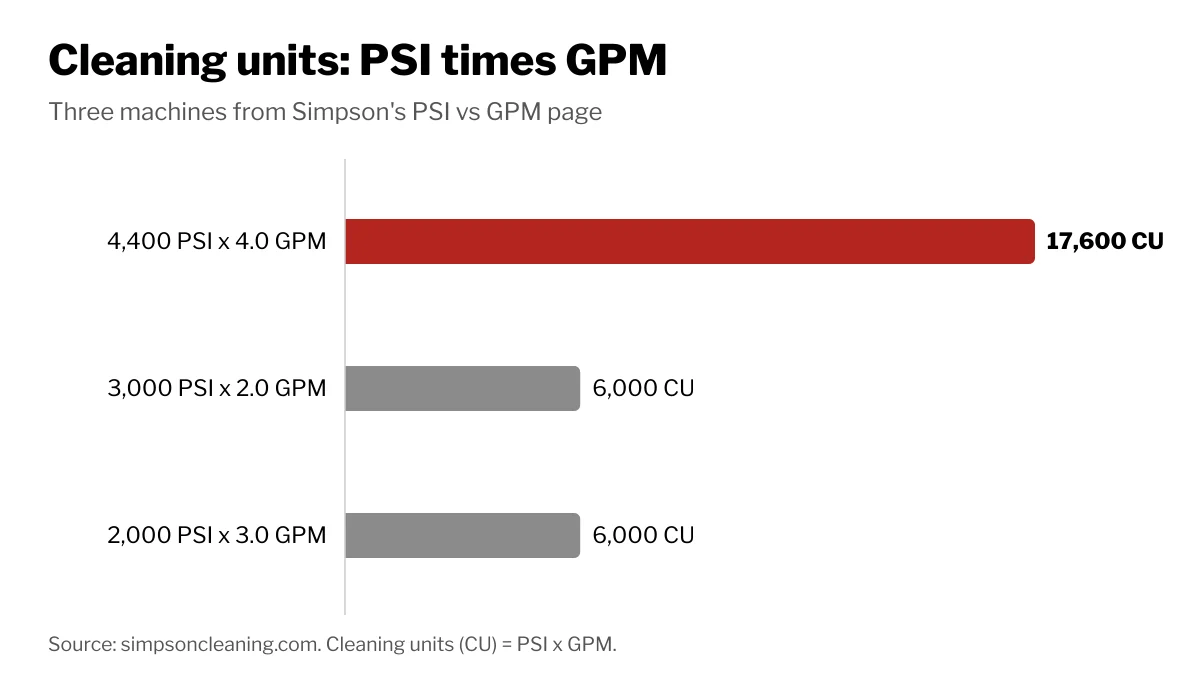
Its own example shows why this helps. A 3,000 PSI, 2.0 GPM machine and a 2,000 PSI, 3.0 GPM machine both score 6,000 cleaning units, even though one looks stronger on the box.
| Machine | PSI | GPM | Cleaning units |
|---|---|---|---|
| Example A | 3,000 | 2.0 | 6,000 |
| Example B | 2,000 | 3.0 | 6,000 |
| Simpson WB60824 (gas) | 4,400 | 4.0 | 17,600 |
Cleaning units are a quick comparison, not a full test. Two machines with the same score still behave differently: the high PSI one bites harder on a small stain, and the high GPM one rinses a wide area faster.
What GPM means in practice
GPM decides how fast you finish. Alkota, which builds industrial machines, says more flow lets you clean larger areas in less time, and that most industrial units sit between 2.5 and 10 GPM. The trade-off: more flow takes more power to drive the pump, so a machine may give up some pressure to gain flow.
Simpson notes that professional cleaners often prefer a higher GPM over a higher PSI. They let a cleaning solution loosen the grime first, so most of the job becomes rinsing, and rinsing is a flow job.
What PSI do you need?
Start from the job, not the biggest number:
- Stubborn, stuck-on stains: lean toward more PSI. Alkota's rule of thumb is more PSI for more knock-down.
- Large flat areas: lean toward more GPM, which covers ground faster.
- Commercial work: Alkota points most commercial buyers to about 3,000 to 4,000 PSI with 3.5 to 5.0 GPM.
For home use, Simpson describes electric models as offering a lower range of pressure and flow than gas models, which sit higher on both. Higher pressure can also damage soft surfaces, so check the owner's manual for the right nozzle and distance before you aim at wood, siding or a car.
Electric vs gas at a glance
| Electric | Gas | |
|---|---|---|
| Pressure and flow | Lower range | Higher range |
| Fits | Lighter, smaller jobs | Bigger areas, heavier grime |
How we count
The PSI, GPM and cleaning unit figures come from Simpson's PSI vs GPM page, including the model named on it; the flow and commercial ranges are Alkota's. Both are linked under Sources.
Shopping on Wiki Shopping
Pressure washers sit in the patio, lawn and garden department. Compare the PSI and GPM on each listing, multiply them, and match the result to the size of your job.