HDR10 vs Dolby Vision vs HDR10+, Explained
HDR10 is the base format every HDR TV plays, while Dolby Vision and HDR10+ add scene by scene instructions; the TV, player and show must share a format.

By Andrian ChengContributing writer.
On this page

The short answer
HDR (high dynamic range) video carries brighter highlights, deeper shadows and more color than standard video. A TV needs instructions to map that range onto its own screen, and the three main formats differ in how those instructions arrive:
- HDR10: one set of instructions for the whole movie or show. Every HDR TV supports it.
- HDR10+: instructions that change scene by scene or frame by frame. Open and royalty free.
- Dolby Vision: also scene by scene or frame by frame, with up to 12-bit color. Licensed from Dolby.
The format only matters when the TV, the player or app, and the content all support it. Otherwise the picture falls back to a format they share, such as HDR10.
Of the 1,062 TVs listed on Wiki Shopping on October 27, 2026, 125 list Dolby Vision.
HDR10 vs HDR10+ vs Dolby Vision compared
| HDR10 | HDR10+ | Dolby Vision | |
|---|---|---|---|
| Metadata | Static (one set per title) | Dynamic (per scene or frame) | Dynamic (per scene or frame) |
| Licensing | Open standard | Royalty free, no per-device royalty | Proprietary, licensed by Dolby |
| Plays on an HDR10-only TV | Yes | Yes, using the HDR10 layer | Depends on the content profile |
HDR10 was announced in 2015 by what is now the Consumer Technology Association. It carries 10-bit color and uses the PQ curve (SMPTE ST 2084) and the wide Rec. 2020 color space. Dolby Vision came first, in 2014, and allows up to 12-bit color. Dolby Vision uses the same PQ curve and supports content graded for up to 10,000 nits of brightness, far more than most TVs can show, which is why tone mapping matters.
Why dynamic metadata helps
With static metadata, the TV gets one brightness range for the whole film. A dark cave scene and a bright beach scene are mapped with the same settings, so one of them may look too dim or lose highlight detail. Dynamic metadata tells the TV how to handle each scene, which helps most on TVs that cannot reach the brightness the content was graded for.
The HDR10+ group says its format is fully backward compatible: an HDR10 TV plays HDR10+ content using only the static part. Some Dolby Vision profiles also carry an HDR10 base layer for the same reason.
Gaming and room light
HDR10+ Gaming brings the scene by scene approach to games; the HDR10+ group lists certain Samsung TVs and some PC monitors as certified. HDR10+ Adaptive uses a light sensor to adjust the picture to the room. Dolby's current page promotes Dolby Vision 2, which it says adjusts the picture to the content and the viewing environment without setup.
Which format should you look for?
- Every HDR TV plays HDR10, so it is the baseline.
- Dolby Vision matters if the streaming services or discs you watch offer it. On Wiki Shopping, 64 listings are large Dolby Vision TVs.
- HDR10+ matters if your services or games offer it. Some TVs support both dynamic formats.
The format is only one part of the HDR picture; the screen itself matters too. See OLED vs QLED vs LED for how screens differ.
How we count
Counts are the Wiki Shopping filter pages for TVs, read from our database on October 27, 2026. A TV counts when its store listing states the feature or resolution. TVs that do not state Dolby Vision may still support it, and the counts change as listings are added or removed.
Shop by spec
TVs
65 inch, 4K, Mini-LED, Google TV

- SQD-Mini LED: As the ultimate Mini LED TV, it integrates the expansive TCL Deep Color System with the breakthrough TCL Halo Control System to ensure the most brilliant, pure, and immersive viewing experience possible.
- TCL Ultra Color Filter: TCL’s Ultra Color Filter with fine 5 nanometer particles (vs. standard 60 nanometer particles) bring every scene to life with pinpoint, pixel-perfect color accuracy.
- High Static Contrast: Experience exceptional picture quality driven by a high 7000:1 contrast ratio for stunning clarity between light and dark scenes.
- High Zones & High Brightness: Up to 4000+ Discrete Dimming Zones and up to 6,000 Peak Nits combine for a picture that is brighter, deeper, and more realistic.
- AI-Powered Experience: Elevate every viewing experience with AI Color for vibrant hues, AI Contrast for dynamic depth, AI Clarity for razor-sharp detail, AI Motion for smooth action, AI Upscaling for lifelike resolution, and AI Sound for immersive, crystal-clear audio.
- Google TV with Gemini: Stop scrolling, start watching. Skip the endless scrolling and chat with Gemini to discover movies and shows tailored for you.
- Home Theater Audio: Experience every whisper and explosion with Audio by Bang & Olufsen, optional wireless subwoofer and satellite speakers that complement the high-performance, built-in speakers.
- TCL Game Pack: A powerful suite of Game Accelerator 288 VRR, Game Bar, and AMD FreeSync Premium Pro, all designed to deliver smoother motion, lower latency, and a more responsive, immersive gaming experience.
- TCL Enhanced Halo Control System – Precise Dimming: An advanced Technology Suite that includes the Super High Energy LED Microchip, Super Condensed Micro Lens, Super Micro-OD Reduced Optical Distance, WHVA 2.0 Ultra Panel, Super Quantum Crystals, Fast Transient Response, 26-bit Dynamic Dimming, and for Stunning “Halo-Free” Images.
- Dolby Vision IQ: Intelligent HDR that adapts to your room, delivering stunning brightness, contrast, and detail in every scene.
32 inch, QLED, Roku
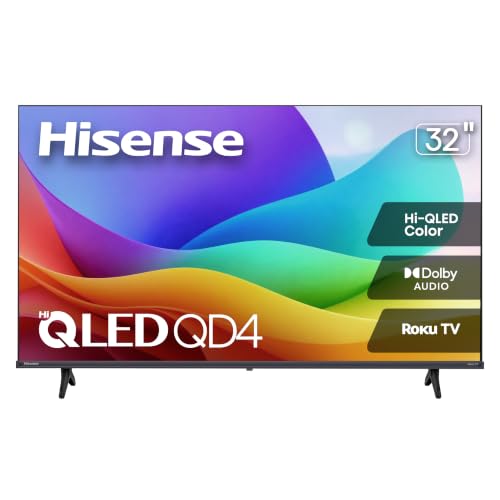
- Hi-QLED Color: Hi-QLED technology makes every shade, scene and skin tone look true-to-life, rendering every scene convincingly real, just as the creator intended.
- Roku OS: America's #1 TV streaming platform. Watch. Stream. Play. Listen. Laugh. Repeat. Kick back and enjoy streaming movies and TV episodes, plus live - streaming news, TV, sports and more, across thousands of free and paid channels. Start streaming your favorite shows.
- Customized User-Friendly Interface: The interface prioritizes intuitive navigation through grid-based layouts and unified iconography, enabling one-tap access to core functionalities (live streaming/on-demand/settings). Key streaming platforms are prominently displayed, minimizing navigation steps to optimize family leisure time.
- Endless Free Entertainment, All in One Place: 5,000+ Free Movies & Shows, 40,000+ Hours of Free Content. Your go-to streaming destination for free live TV, shows, and movies.
- Roku TV Smart System, Self-Upgrading, Always Fresh: Get the newest apps, features, and more with automatic software updates.
48 to 50 inch, 4K, QLED, Google TV

- Art Gallery: The CanvasTV transforms any room into a curated gallery experience, displaying stunning artwork and photography when you're not watching. Choose from more than 1,000 complimentary curated works across styles and eras, or display your own photos and collections. Swap collections, rotate pieces and change the mood of any room. It's not just a TV. It's a piece of art.
- Hi-Matte Display: Every detail the director intended, every shadow, every texture, every expression-comes through exactly as it should. The CanvasTV's anti-glare display eliminates reflections and distractions, so the story on screen is the only thing you see. Whether it's sunlight streaming through the window or a lamp behind the couch, the picture stays rich, clear and completely yours.
- Choose Your Frame – Teak Frame Included: Your art. Your style. Your space. The CanvasTV fits seamlessly into your home and shifts with your mood, from serene watercolors in the morning to bold abstracts in the evening. And with the included Teak Frame, it looks like a piece of art even when it's just hanging on your wall.
- Included UltraSlim Wall Mount: Designed to blend into your room, and take it over at the same time. The CanvasTV sits flush against the wall like a framed piece of art, with no bulk, no clutter and no compromise. Clean lines. Zero gap. All screen. The kind of design that makes guests stop and stare before they even realize it's a TV. And with the wall mount included, getting that perfect, gallery-worthy look has never been easier.
- 4K Hi - QLED Color: Every brushstroke. Every gradient. Every vivid hue-rendered in breathtaking 4K resolution. Whether you're watching a film or displaying a masterpiece, the CanvasTV brings color to life with a level of depth and accuracy that makes everything on screen feel real enough to reach out and touch.
55 inch, 4K, Mini-LED, Google TV

- SQD-Mini LED: As the ultimate Mini LED TV, it integrates the expansive TCL Deep Color System with the breakthrough TCL Halo Control System to ensure the most brilliant, pure, and immersive viewing experience possible.
- TCL Ultra Color Filter: TCL’s Ultra Color Filter with fine 5 nanometer particles (vs. standard 60 nanometer particles) bring every scene to life with pinpoint, pixel-perfect color accuracy.
- HVA 2.0 Pro Panel: The HVA 2.0 Pro Panel provides a stunning picture in nearly any environment with the high contrast, anti-reflective panel.
- Up to LD2100 Precise Dimming Series: Up to LD2100 Precise Dimming Series provides pure black levels with up to 2,100+ precisely controlled discrete local dimming zones.
- AIPQ Pro Processor: Harnessing the power of AI to finely control Picture Clarity, Contrast, Color, Motion, Upscaling, and Backlighting, all dynamically, based on the incoming video signal.
- Google TV with Gemini: Stop scrolling, start watching. Skip the endless scrolling and chat with Gemini to discover movies and shows tailored for you.
- Expandable Home Theater Audio: Experience every whisper and explosion with Audio by Bang & Olufsen, optional wireless subwoofer and satellite speakers that complement the high-performance, built-in speakers.
- TCL Game Pack: A powerful suite of Game Accelerator 288 VRR, Game Bar, and AMD FreeSync Premium Pro, all designed to deliver smoother motion, lower latency, and a more responsive, immersive gaming experience.
- TCL Halo Control System – Precise Dimming: An advanced Technology Suite that includes the Super High Energy LED Microchip, Super Condensed Micro Lens, Super Micro-OD Reduced Optical Distance, WHVA 2.0 Ultra Panel, Super Quantum Crystals, Fast Transient Response, new 26-bit Backlight Controller, and for Stunning “Halo-Free” Images.
- Complete HDR: Utilizing every advanced HDR format available, enjoy vastly enhanced contrast, pristine color accuracy, and details you've never seen before.