USB-C Charger Wattage and GaN, Explained
Use a charger with at least the wattage your device maker recommends; USB-C Power Delivery now reaches 240 watts, and GaN is a smaller build of the same idea.

By Liam McCabeContributing writer.
On this page
The short answer
Find the charger wattage your device maker recommends and buy a USB-C charger that meets or beats it. With USB Power Delivery (USB PD), the device being charged requests the voltage it needs, and Apple, for one, says its USB-C Macs work with adapters above or below the recommended wattage. Going below it costs charging speed.
How USB-C Power Delivery works
USB PD is the charging standard built into USB-C. Before Revision 3.1 it topped out at 100 watts, using 20 volts over a cable rated for 5 amps. Revision 3.1 added higher fixed voltages:
| Voltage | Up to |
|---|---|
| 20 V (with a 5 A cable) | 100 W |
| 28 V | 140 W |
| 36 V | 180 W |
| 48 V | 240 W |
The device can also request in-between voltages from 15 volts up to the charger's highest fixed voltage. The cable counts too: the 240 watt level needs a full-featured USB-C cable built to the matching cable rules. See USB cable types for how cables are rated.
What wattage do I need?
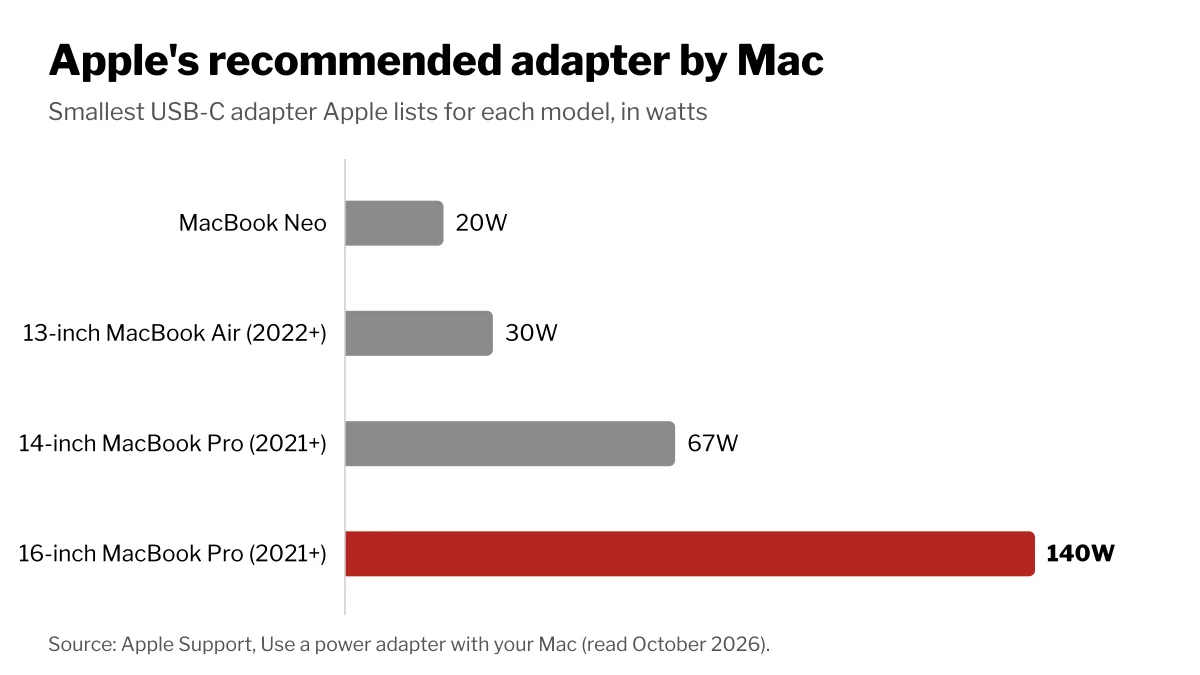
Start with what the device maker publishes. Apple is a clear example:
| Device | Adapter Apple lists |
|---|---|
| MacBook Neo | 20W |
| 13-inch MacBook Air (2022 or later) | 30W, 35W, 67W or 70W |
| 14-inch MacBook Pro (2021 or later) | 67W, 70W or 96W |
| 16-inch MacBook Pro (2021 or later) | 140W |
Apple says a USB-C Mac charges from any USB-C power adapter, even one above or below the recommended wattage, but charges best with at least the recommended wattage.
Phones need less. Apple's fast charging page says iPhone 15 and later fast charge with an 18 watt or higher USB-C PD adapter. iPhone 17, 17 Pro and 17 Pro Max reach about 50 percent in around 20 minutes with a 40 watt or higher adapter, and iPhone 17e and iPhone Air need 20 watts or more to fast charge. Android makers publish their own figures, so check the phone's support page.
What a GaN charger is
GaN stands for gallium nitride, a semiconductor material used in the charger's power parts instead of plain silicon. Belkin explains that GaN runs more efficiently and makes less heat, so the parts can sit closer together and the charger can be smaller for the same power. Belkin notes that most GaN chargers include USB PD, so fast charging still depends on the device supporting it.
Multi-port chargers
A charger with two or three ports has one total wattage for all of them. Add up what each device needs and make sure the total fits, and check the maker's chart for how the power splits when several ports are in use. Belkin's own guidance suggests 30 to 45 watts for a phone and 60 watts or more for a laptop.
Quick checklist
- Look up the wattage your laptop or phone maker recommends.
- Buy a USB PD charger at or above that number.
- Use a cable rated for the same wattage.
- For several devices, add up their needs before picking a multi-port charger.